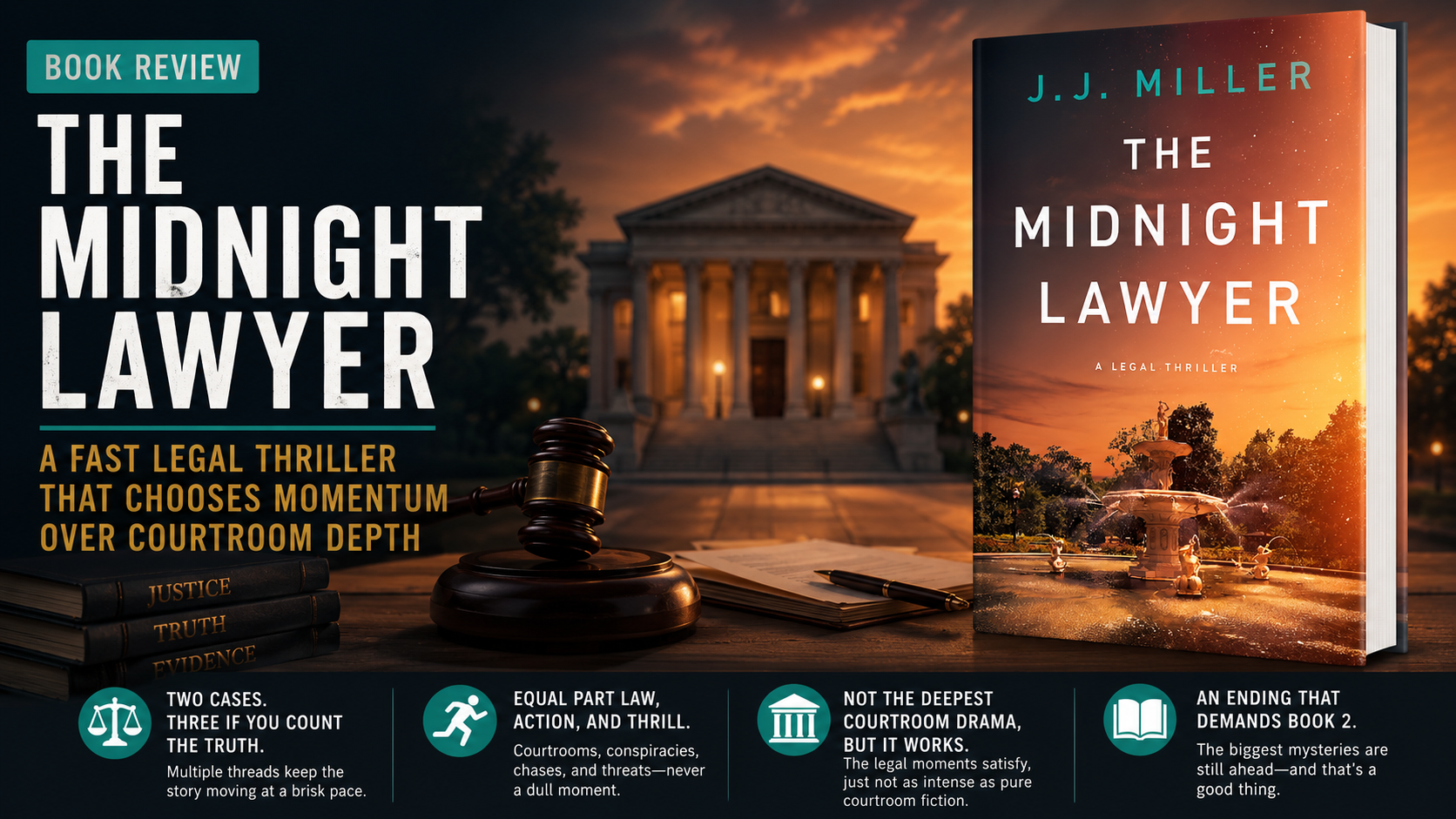
What do you really want from a legal thriller? A tense courtroom chess match? A morally complicated lawyer? Or simply a story that keeps moving, keeps twisting, and keeps giving you reasons to turn the next page?
The Midnight Lawyer by J. J. Miller clearly chooses the third option—and for many readers, that will be enough.
This is not a slow-burning procedural obsessed with legal nuance. It is a fast-moving thriller that happens to operate inside the legal world. That distinction matters, because readers expecting something in the vein of The Lincoln Lawyer may walk in expecting extended courtroom battles and intricate trial strategy. What Miller delivers instead is something broader: equal parts law, conspiracy, action, and family drama.
Defense attorney Hank Luger returns to Savannah after leaving behind a successful Washington career. The setup is familiar but effective: a hometown layered with old power structures, buried history, and unresolved family tension. Hank wants a quieter life. Naturally, the city has other plans.
His first major case involves a young woman facing aggressive charges after reporting an assault. Soon after, Hank becomes connected to Pharaoh Williams, a death row inmate convicted during the era when Hank’s father served as district attorney. From there, the novel begins stacking mysteries on top of one another.
Two simultaneous legal cases—three, really, if you count the larger family conspiracy—give the novel its momentum. There is always another lead, another threat, another revelation waiting around the corner. Miller understands pacing well. Even when certain twists feel predictable, the story rarely becomes dull.
That predictability is worth mentioning because seasoned thriller readers will likely see some developments coming early. But predictability is not always fatal in commercial suspense fiction. Execution matters more. The real question becomes: does the book keep you engaged?
For the most part, yes.
Where The Midnight Lawyer succeeds is in maintaining forward motion. The chapters are structured to keep tension alive, and the overlapping cases create a constant sense of progression. There is very little downtime. Even when the legal elements become lighter, the thriller mechanics continue pushing the story forward.
The tradeoff is courtroom depth. Because the novel splits its attention across multiple investigations and an overarching mystery, the legal drama itself sometimes feels thinner than expected. The courtroom scenes are functional rather than electrifying. Readers looking for intense cross-examinations, strategic legal maneuvering, or deeply immersive procedural detail may find themselves wanting more.
This is not the kind of legal thriller where the courtroom becomes the entire battlefield.
Instead, Miller leans into a hybrid approach. The law is only one part of the machine. The rest is driven by hidden evidence, corruption, intimidation, family legacy, and escalating danger outside the courtroom walls.
That balance will divide readers depending on expectations. Hank Luger himself lands somewhere in the middle as a protagonist. He is neither intensely charismatic nor frustrating enough to drag the story down. He functions well inside the plot, but he does not yet have the distinct personality that defines the genre’s most memorable legal-thriller leads. Readers comparing him to Michael Connelly’s Mickey Haller or Victor Methos’ sharper protagonists may notice the difference immediately.
Still, Hank remains readable because the novel wisely understands where its strengths lie: movement, tension, and mystery.
The father-son dynamic also gives the book some needed emotional weight. George Luger’s role in Savannah’s legal history hangs over nearly every major development, and the uncertainty surrounding his loyalties adds intrigue beneath the procedural surface. That tension becomes more compelling as the story unfolds.
Without spoiling anything, Book 1 closes on exactly the kind of unresolved note that thriller series readers tend to love. The immediate story reaches enough closure to feel satisfying, but the larger mystery remains alive in a way that makes Book 2 difficult to ignore. Of course, there are viewers who completely hate cliffhangers, so it is a double-edged sword.
The Midnight Lawyer may not reach the heights of the genre’s best courtroom dramas, but it understands how to keep readers engaged. It moves quickly, balances multiple storylines effectively, and delivers enough suspense to make the pages disappear fast.
If you are looking for dense legal realism or unforgettable courtroom strategy, this may not fully satisfy you. But if you want an entertaining legal thriller that mixes action, conspiracy, and steady momentum, J. J. Miller delivers a solid start to what could become a very readable series.